
Your System Will Be Offline
Depending on roof size, complexity, and inspection scheduling, expect several days to a couple of weeks without production. We give you a realistic window up front instead of a comfortable one.
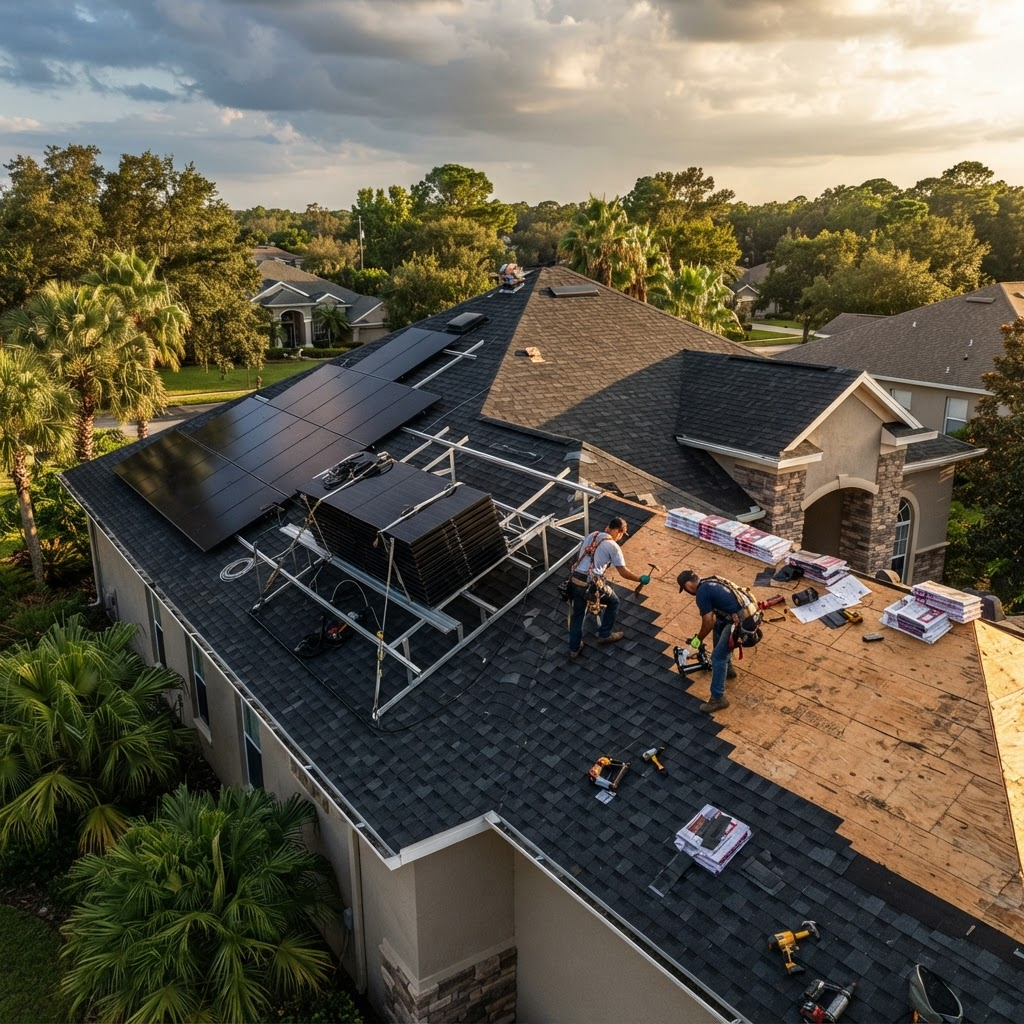
Panels do not last forever, but they usually outlast the roof underneath them. When it is time to re-roof, the array has to come off and go back on without damaging the panels, voiding the warranty, or leaving forty new holes in your deck. That is a specialty, not an afterthought.
Detach and reset is the process of removing a solar array from a roof, storing it safely, completing the roofing work underneath, and reinstalling the system so it produces exactly like it did before.
It sounds simple. It is not. Every panel is wired into a live DC system. Every mount is a penetration through your roof deck that was flashed by somebody else, years ago, to a standard you cannot verify from the ground. Every rail run has to land back in the right plane or the array will not sit flat. And the whole thing has to come back online and pass inspection.
Most roofers either refuse this work or hand your array to whoever is cheap and available. We treat it as its own scope with its own plan.
We document the existing array first: panel count, model, layout, racking system, mount type and spacing, inverter configuration, and conduit routing. We photograph the system in place and record production data where the monitoring platform allows it. That baseline is what proves the system came back the way it went out. We also confirm the ownership structure of your system before we quote, because owned, financed, leased, and PPA systems are not the same, and that distinction changes who is allowed to touch the array.
The electrical disconnect and reconnect is performed by a licensed solar or electrical contractor. Roofing is our license. Photovoltaic electrical work is not, and we are not going to pretend otherwise or have a roofing crew pulling DC conductors because it saves a phone call. We coordinate the correct trade, on schedule, so the trades are not tripping over each other.
Panels come off, get labeled by position, and go into protected storage on site or at our facility, not stacked in your driveway under a tarp. Racking and hardware is removed and inventoried. Anything corroded, cracked, or already failing gets flagged to you before we reinstall it.
This is the part that matters most and it is the part nobody sees. With the array off, we have full access to a deck that has not been visible in a decade. We inspect and replace damaged sheathing, re-nail to current code, and install the new underlayment and roofing system as a complete, uninterrupted assembly. Every abandoned mount penetration gets properly sealed and integrated into the new system. Old holes do not get a bead of caulk and a prayer.
Racking goes back with new flashed mounts, set into the new roof the way a new install would be. Panels return to their labeled positions. The licensed electrical trade reconnects the system, verifies the inverter comes up, and confirms production.
We do not call it finished because the panels are back on the roof. We confirm the system is producing, deliver the inspection documentation, and give you the before and after record of the array.
Depending on roof size, complexity, and inspection scheduling, expect several days to a couple of weeks without production. We give you a realistic window up front instead of a comfortable one.
If your array is leased, financed, or on a power purchase agreement, your agreement may require the provider to authorize or perform the removal. Some providers charge for this and some will not permit a third party to touch the equipment at all. We tell you this before you sign anything with us, and we work with the provider’s process. Finding out afterward is expensive.
Panel and inverter warranties can be affected by who removes and reinstalls the equipment. This is another reason the electrical scope goes to the correct licensed trade.
A ten or fifteen year old array has microcracks and degraded seals you cannot see. Handling matters. We inspect and document panel condition before removal so nobody is arguing later about damage that already existed.
Some interconnection agreements require notification or reinspection before the system goes back online. We flag this early so it is not a surprise at the end.
If your roof is being replaced under an insurance claim, the removal and reinstallation of your solar array is part of the cost of repairing the roof. It is a recognized, separately measured scope of work, and it is frequently omitted from a carrier's initial estimate simply because the desk adjuster never saw the array.
We document the system, measure the scope, and provide a written estimate for the detach and reset work as its own line item so it can be submitted with the rest of the claim. You file and control your claim. Our job is to make sure the scope in front of your carrier reflects the actual work your roof requires.
If your roof genuinely has years left in it, we will tell you that and you can keep your money.
The roofing work under your array is done by our crew, to the same standard as any other replacement we install.
Electrical scope goes to a licensed electrical or solar contractor. Permits get pulled for both scopes where required.
Panel positions, mount locations, pre-existing conditions, production baseline. You get the record.
Manatee, Hillsborough, Pinellas, Pasco, and Sarasota counties.
Free inspection and a written scope covering both the roof and the array. Tell us what you have and we will tell you what it takes.
NextDoor Exterior Solutions, LLC
2303 S Dock St, Palmetto, FL 34221
Florida Certified Roofing Contractor CCC1334600